
Business Interruption Insurance for Orange County Restaurants: Fire, Outages, and Coverage Gaps
A practical guide for Orange County restaurant owners to compare business income, extra expense, utility outage, spoilage, and flood coverage before a closure.
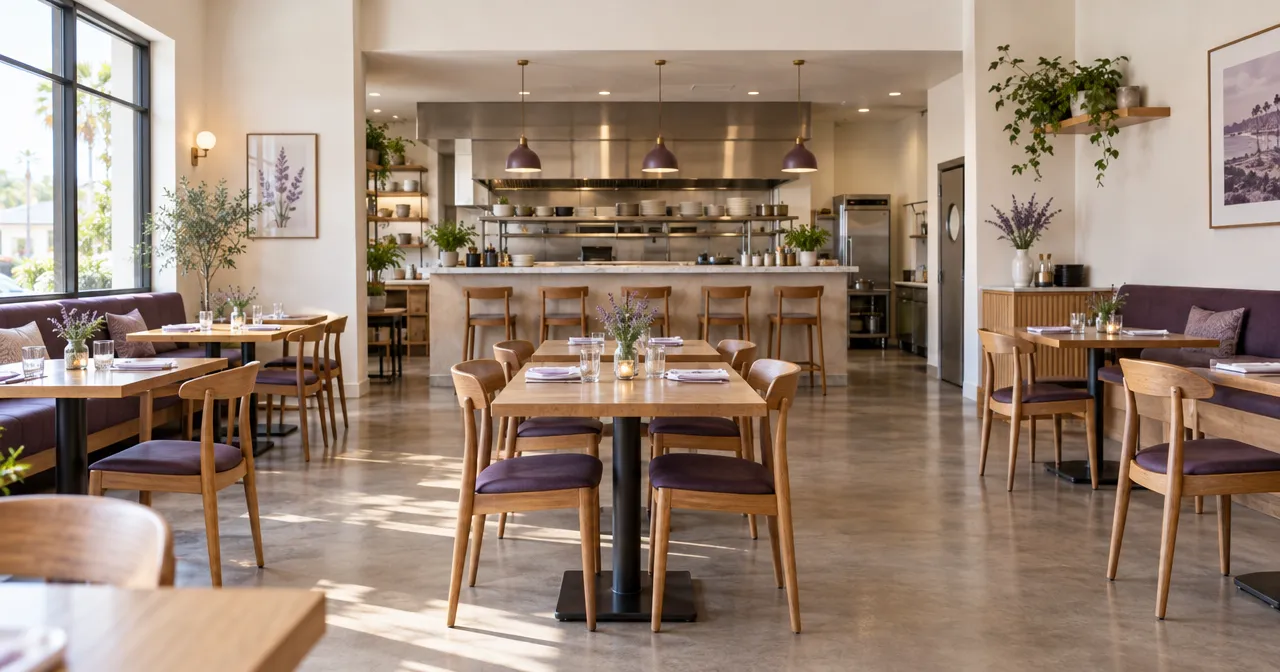
A restaurant can lose revenue long before repairs are finished. A small kitchen fire might shut down the line, damage the hood system, and require inspections before anyone can serve another meal. The property claim may address damaged equipment and finishes; it does not, by itself, answer how the restaurant will pay rent or replace income while the doors are closed.
For owners in Huntington Beach and across Orange County, business interruption insurance—often called business income coverage—is the part of a commercial insurance plan designed to address certain financial losses during a covered shutdown. The hard part is deciding which interruptions count, how long coverage lasts, and whether the policy includes the smaller risks that can be devastating to a restaurant, such as a refrigeration failure or an off-premises power outage.
This guide is a framework for reviewing a policy, not a prediction of whether any particular claim will be paid. Coverage depends on the policy form, endorsements, cause of loss, limits, and facts of the event. The California Department of Insurance’s commercial insurance guide is a useful starting point for the distinctions among property, business income, extra expense, and liability coverage.
Start with the trigger: a covered loss, not simply a slow week
In a common commercial property arrangement, business income is time-element coverage: a covered cause of loss damages covered property, operations are suspended or reduced, and the loss of income is measured over a defined restoration period. A fire that damages a restaurant’s kitchen is an intuitive example. A decline in reservations because nearby construction makes parking inconvenient usually is not the same kind of event.
The property policy’s covered causes matter. If flood or earthquake is excluded from the underlying property coverage, ordinary business income coverage generally does not spring into action simply because the restaurant is closed after that event. Ask the carrier or agent to identify the exact covered cause, location, waiting period, and applicable endorsement before assuming a shutdown qualifies.
A restaurant may obtain business income as part of a business owners policy (BOP), a commercial package, or a separate property arrangement. Do not infer that two proposals contain the same interruption terms just because both say “BOP.” Compare the actual forms and declarations, especially sublimits and endorsements.
Separate the three buckets: property, income, and extra expense
Imagine a covered fire disables a walk-in cooler and forces a temporary closure. The costs can fall into different buckets:
- Commercial property addresses covered physical damage to insured equipment, inventory, tenant improvements, or the building, depending on who owns each item and what the policy lists. A tenant’s lease does not automatically make the landlord’s building part of the tenant’s property coverage.
- Business income addresses eligible lost earnings during the covered suspension. The calculation usually looks at income that would have been earned and continuing expenses, not every dollar of gross sales.
- Extra expense can address reasonable additional spending needed to keep operating or reduce the closure after a covered loss—such as temporary refrigeration, a short-term prep space, or notices to customers—subject to the form’s conditions and limits.
The distinction prevents two common mistakes: treating damaged food as “lost income,” and assuming a property limit that replaces a cooler will also finance a month of payroll and rent. Some policies combine business income and extra expense; others set separate limits. Check whether food spoilage, equipment breakdown, and utility interruption appear as distinct coverages.
A simple calculation—not a claim estimate
Suppose a hypothetical restaurant ordinarily expects $80,000 in monthly sales, with $28,000 in costs it would avoid while closed, $35,000 in continuing expenses, and $17,000 in expected net income. A full-month shutdown would put roughly $52,000 of expected contribution at risk before applying policy terms: $35,000 in expenses plus $17,000 in net income. It would not automatically be an $80,000 business income claim.
If the restaurant manages $15,000 in takeout sales and spends $6,000 to produce those meals, the $9,000 net contribution from that activity changes the illustrative shortfall to $43,000. Actual adjustment can account for seasonality, saved costs, mitigation, waiting periods, limits, and the date operations reasonably could resume. A claim also needs records. The example is deliberately simplified; it is not a formula that substitutes for the policy or an adjuster’s review.
How long would the restaurant need protection?
The period of restoration is not necessarily the date the final invoice arrives or the day sales return to their old level. Policy wording governs when the period begins and ends; a waiting period may delay when business income starts. A separate extended-business-income feature may be available for a limited period after reopening, but it should never be assumed.
Walk through the actual recovery sequence: fire investigation, landlord approval, equipment availability, contractors, permits or inspections when required, staff scheduling, and restocking. A small sandwich shop that can relocate prep quickly may have a different timeline from a restaurant whose custom ventilation equipment must be replaced. During a review, compare the policy’s time limits and dollar limits with a realistic timeline—not only the cost of repairing the kitchen.
Ask also whether the business income limit uses a dollar cap, a monthly limitation, a defined period, or a coinsurance provision. Those mechanisms affect the amount available even when the cause of loss is covered. If weekend, holiday, or summer sales are materially different from the rest of the year, keep financial records that show the pattern and consider it in the limit discussion.
Power outage, refrigeration failure, and spoiled food are different questions
An outage at the restaurant may originate inside its own equipment or elsewhere on the utility network. That distinction changes the insurance analysis. A damaged panel on the premises, failure of a walk-in compressor, and a neighborhood-wide grid outage are not interchangeable causes under a property policy.
For an off-premises utility interruption, ask specifically whether utility-services coverage applies to business income and extra expense, to direct damage, or both. Review which services and equipment count, whether utility property must suffer covered physical damage, whether overhead lines are included, and any waiting period or sublimit. The Insurance Information Institute’s explanation of business interruption endorsements distinguishes utility-services time-element coverage from direct-damage coverage and discusses other optional extensions.
Spoilage is another question. A spoiled-food limit may cover the stock itself under specified circumstances but not the lost dinner service; an interruption extension may address lost income but not every spoiled ingredient. Equipment-breakdown coverage may be relevant to a failed compressor, but its scope, exclusions, deductibles, and any related business-income extension must be checked. Document refrigeration temperatures and inventory promptly, follow applicable food-safety requirements, and ask the insurer before disposing of damaged property when it is safe to do so. Do not keep unsafe food merely to preserve claim evidence; photographs and inventory records can help document what was discarded.
Coastal flooding and earthquakes need their own review
Huntington Beach owners should not treat “near the coast” as a coverage category. The question is whether their particular site, equipment, and operations face flood or other water exposure—and which policy would respond. Commercial property policies commonly exclude flood and earth movement, so a restaurant should evaluate separate flood and earthquake protection rather than assume ordinary fire coverage extends to either event.
Flood insurance for the building or contents should be distinguished from business income. The National Flood Insurance Program’s guide to commercial flood coverage says its commercial building and personal property policies do not cover financial losses from business interruption or loss of use. If shutdown income after flooding is a priority, ask whether a separate private-market solution or endorsement is available and how it coordinates with any flood property policy. Likewise, ask whether any earthquake property coverage includes a business-income feature; do not infer it from the word “earthquake” on a declarations page.
The same discipline applies to water that enters from a plumbing leak versus water that rises from outside. Causes and exclusions can differ, and a single word—“water”—does not resolve the claim.
What if an order closes the street but the restaurant is undamaged?
A nearby building fire might prompt authorities to block access to a restaurant for several days. Some policies have civil authority coverage, which may extend business income or extra expense when access is prohibited because of covered physical damage to other property. Terms vary, including the required type and distance of damage, what qualifies as a prohibition of access, any waiting period, and the duration of coverage.
A general traffic detour, voluntary closure, or loss of foot traffic is not automatically a civil-authority claim. If an official order affects the restaurant, save the actual order, its effective times, the location of damaged property, and evidence of how access was restricted. Ask for the specific civil-authority language rather than relying on a summary of coverage.
Review the rest of the insurance program, too
Business interruption does not replace a restaurant’s other core policies. General liability addresses certain third-party bodily injury and property-damage claims, including premises and product exposures under the applicable terms. Workers’ compensation addresses qualifying work-related employee injuries and is generally required for California employers. A delivery or catering vehicle raises commercial auto questions. Businesses that store customer or payment data may need to assess cyber liability. Liquor sales, if applicable, require a separate discussion of liquor liability rather than an assumption that ordinary general liability covers it.
The restaurant’s physical setup matters just as much. Is the hood system owned by the tenant or landlord? Are improvements and betterments listed? Does the business store inventory off-site, operate a patio, use a commissary kitchen, or rely on a single supplier? A new location or expanded delivery service is a reason to revisit both property and liability coverage, not merely increase an income limit. J G Petit Insurance Agency works with business owners to compare carrier options and explain these tradeoffs in the context of their operations.
Keep evidence and a workable reopening plan
Insurance is one part of continuity planning. Ready.gov’s business continuity planning guidance recommends organizing a team and preparing and testing a plan for disruptions. For a restaurant, make the plan concrete:
- Before a loss: Keep monthly sales, payroll, rent, food-cost, and inventory records accessible outside the premises. Photograph major equipment, note serial numbers, and save the lease and insurance forms. Identify who can authorize emergency repairs, speak to the carrier, and decide whether limited takeout or a temporary site is feasible.
- When a disruption occurs: Protect people first. Report the event to the insurer promptly, follow local safety and health requirements, and take reasonable steps to prevent additional damage. Record when service stopped, what equipment failed, and any order that limits access.
- During recovery: Keep invoices for repairs and temporary operations, daily sales reports, canceled reservations or catering orders, inventory disposal documentation, and notes of conversations with the adjuster. Separate costs that would have occurred anyway from costs incurred because of the event.
Records make it easier to explain the difference between expected sales, saved expenses, actual partial operations, and extra expenses. They do not guarantee payment; they give the insurer and business a more reliable basis to evaluate a claim.
Questions to bring to an insurance review
Bring the current declarations, endorsements, lease, and a recent profit-and-loss statement. Then ask:
- Which property perils can trigger our business income coverage, and which are excluded?
- Is business income already in our BOP or package, and where are the limit and waiting period stated?
- Is extra expense separate or combined with the income limit? What costs qualify?
- How is the restoration period defined, and is there coverage for a slow return to normal sales after reopening?
- Are utility-service interruption, equipment breakdown, and food spoilage covered? If so, what are their separate triggers, limits, and deductibles?
- What happens after a flood or earthquake, and does any separate property policy also address lost income?
- Does civil-authority coverage require covered damage near the premises and a formal access restriction?
- Are tenant improvements, food stock, and landlord-owned systems correctly assigned between the lease and the policies?
- How would a second location, catering, delivery, or liquor service change the program?
A lower premium can be attractive, but two proposals that treat a week-long power outage differently are not equivalent. An independent review should identify those differences in plain language and let the owner decide which risks to retain and which to insure.
Make the shutdown scenario specific to your restaurant
A Huntington Beach café, an inland Orange County restaurant, and a catering kitchen may share the same basic business-income concept but depend on different equipment, customers, property arrangements, and suppliers. The useful question is not “Do I have interruption insurance?” It is “What event would stop my operation, and what would the actual policy pay while I recover?”
J G Petit Insurance Agency can review your commercial property, BOP, business income, liability, and related coverage together, compare available options across carriers, and explain the remaining gaps. Contact the agency for a personalized discussion of your restaurant’s operations and coverage needs.